Horror
Bedlam Psychiatric Hospital: The Building Built to Frighten Sufferers
The history of psychiatric care and the image of fear born from the walls of a London asylum.
From a Priory in Bishopsgate to a Psychiatric Hospital
Bethlem was founded in 1247 as the Priory of St Mary of Bethlehem by Simon Fitzmary, a council member and former sheriff of the City of London. Its location was outside the city wall, in the area of Bishopsgate Without. [1][3] At first, the building was not designed as a psychiatric hospital, but as an alms center for the Church of the Holy Cross and lodging for paupers and worshippers. [1] The first definitive record of the admission of mental patients appeared in 1403, when its commission recorded six men described as 'mente capti', a Latin term for madness. The inspection report also mentioned four pairs of handcuffs, 11 chains, six keys, and two pairs of shackles, although it is unclear whether all were used to restrain patients. [1] By 1460, the transition from a small general hospital to an institution specifically for the confinement of insane persons was nearly complete. [1] The name 'Bedlam' itself began to be known informally from the 14th century as 'Bedleheem', 'Bedleem', or 'Bedlam', and since the Jacobean era it entered everyday language to denote madness, chaos, and the irrational nature of the world. [1]
In 1547, King Henry VIII handed management of Bethlem to the City of London, making the hospital one of the City's five Royal Hospitals. [3] From the 1570s until the introduction of the NHS in 1948, Bethlem was administered jointly with Bridewell by the Board of Governors. [3] At that time, medieval thought regarded madness as a bodily disease, not a brain disease, which could be cured by cleansing the 'melancholic humor' through vomiting, diarrhea, bloodletting, burning the skin with caustic substances, shaving hair, and cold-water baths. Treatment was repeated 'as long as strength lasted' and often resulted in death. [2]
The Architecture of Display and the Tourism of Madness
In 1676, Bethlem moved from a cramped mid-century building in Bishopsgate to a grand and luxurious hospital in Moorfields. [2] The cost of constructing the new building reached £17,000. [1] Bethlem remained England's sole mental health facility, and a nepotistic tradition of appointing medical posts among friends and family ensured that treatment methods were passed down. [2] The name was also popularized through Jacobean and Caroline dramas, such as The Duchess of Malfi (1612) and The Changeling (1622). [1]
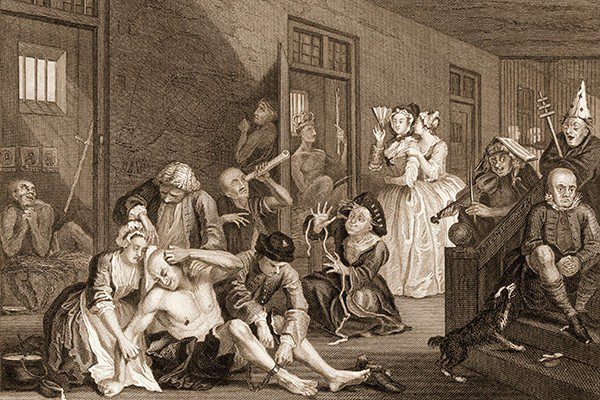
The Moorfields building also became a tourist attraction. In the 1750s, Bethlem received tens of thousands of paying visitors each year, making it a major attraction for Londoners, second only to St Paul's Cathedral. [2] For as little as one penny, anyone could enter the wards to stare at, mock, or abuse the inpatients. [2] Visitors included Samuel Pepys, Dr Johnson, and William Hogarth. [2] Diarist Ned Ward, who visited in 1699, described the sound of rattling chains, creaking doors, nonsense, shouting, and singing, and compared the atmosphere to a leaking hell. [2] Visitors mocked through bars and peepholes; some patients spat or threw objects, while those suffering from 'melancholia' did not respond at all. [2]
The architecture itself supported the display. In 1689, iron railings were installed at the gallery doors, allowing unrestrained patients to walk in the gallery while preventing contact between male and female patients. [1] In 1742, it became customary for guards to ask foreign visitors for at least one penny. [1] Public visits were banned on Sundays from 1657 and reduced from 1770, but the tradition of exhibiting sufferers had stamped Bedlam's image as a place of madness and ruin. [1]
The 1814 Report: Cells, Chains, and the Norris Case
A darker horror was revealed in 1814. Inspectors found a woman named Anna Stone naked, filthy, and chained with several others to the damp, dark walls of a stone cell. [2] The inspectors judged the hospital to have 'the appearance of a dog kennel'. [2] Edward Wakefield, a reformer, made visits on April 25, May 2, and June 7, 1814. [1] He recorded that about ten women in one side room were chained by one arm to the wall, with only enough length to stand near a bench or sit, their nakedness covered only by a blanket. Other women were locked in cells, naked and chained to straw. In the male wing, six patients were chained by the right arm and right leg. [1] In 1815, Wakefield reported a naked man who rose from his bed and walked a few steps, then was immediately seized by attendants, thrown onto the bed, and locked by the foot, without examination; chains universally replaced straitjackets. [1]
On June 7, 1814, Wakefield brought an artist who made a drawing of a patient named Norris. The image was engraved and widely distributed, becoming an important propaganda tool in the movement to reform lunacy policy. [1] However, claims of 96,000 visits per year in the 18th century or 1815 are not supported by the 1815–16 parliamentary inquiry reports, and the estimate is attributed to an unverified calculation from a 1914 history. [1] This shows that some popular narratives about Bedlam need to be separated from archival records.
Reform, Relocation, and a Legacy That Still Whispers
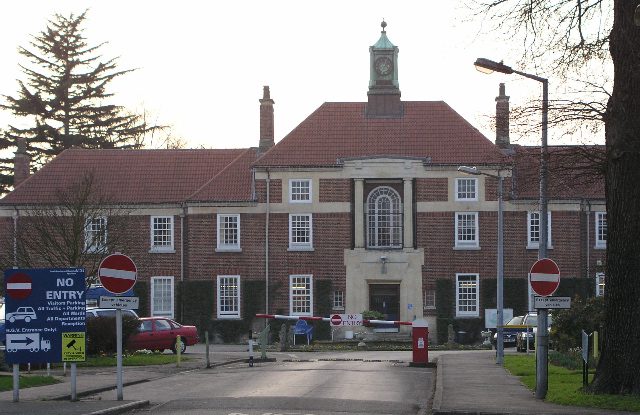
A major turning point came in 1852, after the last visiting physicians, Alexander Morison and Edward Thomas Monro, departed, and Charles Hood was appointed as the first resident physician. Bethlem unconditionally adopted a policy of no restraints and moral management. [1][3] A convalescent unit in the countryside was established in 1870, and an outpatient clinic for voluntary patients, the first in England, opened in 1919. [1][3] The hospital moved three times: to Moorfields in 1676, to St George's Fields in Southwark in 1815, and finally to Beckenham, Kent, in 1930. [1][3] In July 1948, when the NHS was introduced, Bethlem was administratively merged with Maudsley Hospital. [1][3] In 1999, Bethlem and Maudsley were merged with other South London mental health services to form the South London and Maudsley NHS Trust. [1][3]
Today, the hospital is located on Monks Orchard Road, Beckenham, London, with about 350 beds. [1] The name 'Bedlam' lives on as a common word for chaos and madness, and its history has inspired books, films, and horror television series, including the 1946 film Bedlam starring Boris Karloff. [1] The building that once exhibited sufferers as public spectacle now operates as a modern psychiatric hospital, but traces of chains and display still whisper in the city's memory. [1][2]
Gallery
Sources and further reading
- Bethlem Royal Hospital - Wikipedia Mendukung pendirian 1247, catatan pasien 1403, pindah gedung 1676/1815/1930, laporan Wakefield 1814, reformasi 1852, dan status saat ini.
- Bedlam: Why Did The Infamous Asylum Have Such A Fearsome Reputation? | HistoryExtra Mendukung wisata publik, jumlah pengunjung, pengawasan 1814 atas Anna Stone, perawatan abad pertengahan, dan perdebatan dokter.
- Bethlem Royal Hospital Mendukung pendirian 1247 oleh Simon Fitzmary, rujukan pertama pasien jiwa 1403, pengalihan 1547 ke Kota London, dan gabungan NHS 1948.
This story was drafted with AI assistance and edited against googs’s editorial guidelines. Primary sources are linked below.